Table of contents
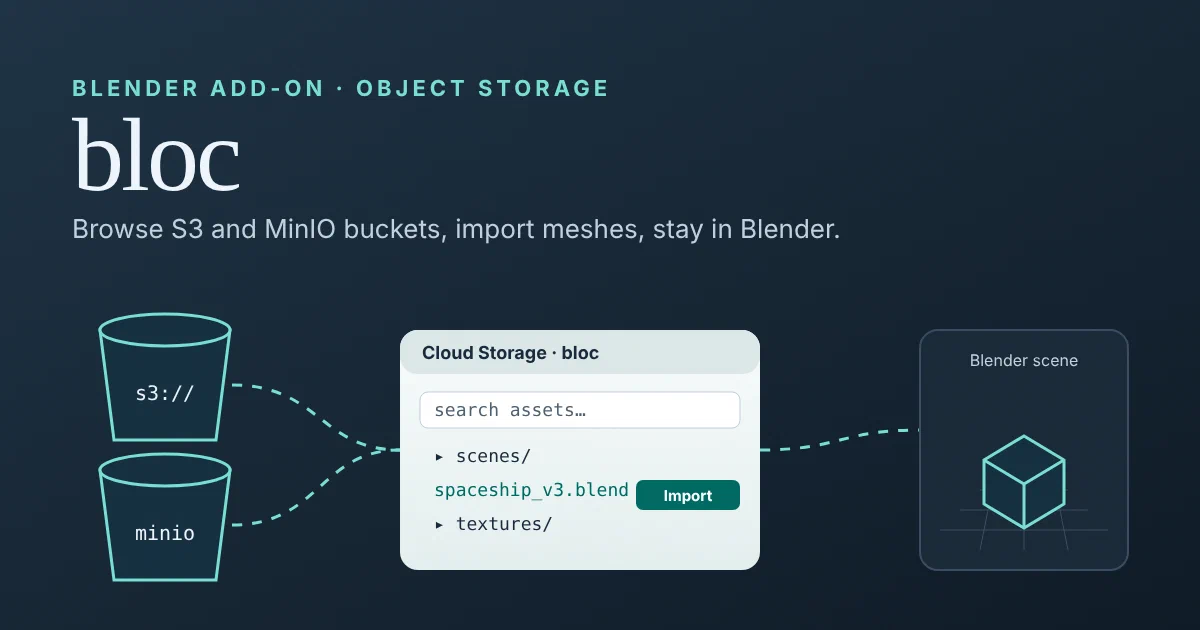
My bloc repository[1] is a fork of MrKuros/Blender-Cloud-Storage[2]. It keeps the upstream author credit and explores a Blender panel for browsing assets in AWS S3 and MinIO.
1. The browsing and import paths
flowchart LR
  Storage["S3 or MinIO"] --> Listing["Folder listing"]
  Listing --> Panel["Blender panel"]
  Panel --> Download["Download selected asset"]
  Download --> Import["Local Blender importer"]
Listing creates the panel’s folder view; loading an asset downloads its bytes and invokes a local importer. A listing refresh can therefore succeed while an import fails on an unsupported format. The background refresh hands UI updates back through Blender timers instead of treating the storage request as a UI operation.
Read the architecture note with the connection and import boundaries.
2. Make the connection explicit
addon.py[3] defines a CloudConnection property group with a provider, endpoint, bucket and region. Preferences hold multiple connections and an active connection index. The client setup chooses the S3 or MinIO path from that selection.
This is the part that interests me as both graphics and platform work: the artist works inside Blender, while the add-on translates those actions into object-storage operations.
3. Turn object names into folders
Object storage uses keys. The refresh operator splits those keys on / and builds a nested dictionary for the panel. Folder expansion is tracked separately, so the UI can browse a hierarchy without pretending it is a local filesystem.
CloudSearchManager adds fuzzy matching with RapidFuzz. It scores filenames and path segments, gives direct substring matches priority and supports filters for scenes, meshes, images and materials.
4. Downloading and importing are different actions
The download helper saves an object to a temporary local path. The load operator then selects a Blender importer for STL, OBJ, PLY or USD variants. Other extensions are rejected with a message. A successful transfer alone does not mean Blender has imported a usable object.
The upload-current-file operator sends the saved .blend file. Although the README discusses dependencies, I would verify texture packaging and relative paths before relying on this path to move a complete scene.
5. Keep the fork’s scope visible
The public upstream comparison[4] showed 10 commits ahead and 5 behind on October 23, 2026. The changed files include the add-on, packaging metadata and README. That describes repository history; it does not establish that upstream accepted those changes.
The source also uses a single S3 list_objects_v2 request, so buckets beyond one response need pagination work. These are the kinds of small workflow boundaries I want to keep visible when revisiting the project.