
Table of contents
Couplage contact-apparence pour l’usure de surfaces microstructurées en simulation interactive — my ÉTS master’s thesis (English abstract title: Visual Appearance Evolution from Wear on Microstructured Surfaces in Texture Space). Directed by Sheldon Andrews, defended 14 August 2026. The core idea: give material maps a persistent local memory of contact. Body travel alone cannot predict where wear shows up.
1. The gap
Real surfaces keep a trace of friction and slip. Interactive simulators usually throw that away at the end of each timestep. The contact solver already computes impulses, relative velocity, tangential traction, and dissipation — then updates rigid-body motion and stops. Material maps (albedo, roughness, normals) stay fixed unless an artist paints wear by hand.
The thesis closes that loop: mechanical contact resolution feeds texture-space appearance evolution at the places contact actually happened.
2. Pipeline (one glance)
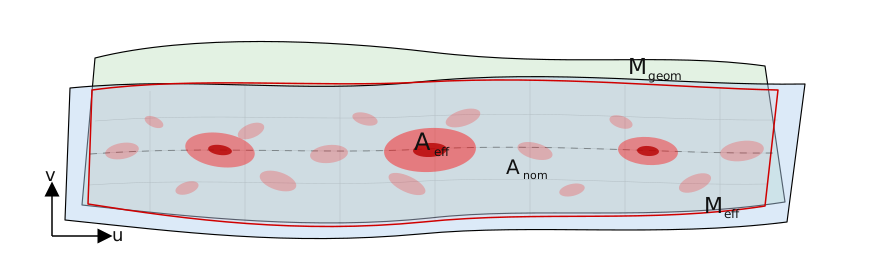
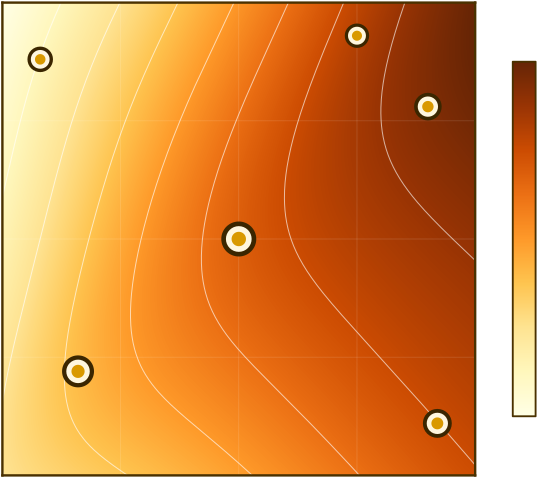
Sparse contacts are grouped into local patches, projected into material atlases, and reconstructed as tangential velocity, effective traction, and frictional dissipation on a GPU patch grid. Those fields drive accumulation of sliding distance, dominant direction, and wear — then progressive map updates without global remeshing.
Source: wear-pipeline-flow.mmd (same chain as GraphQuon 2025). The interactive implementation in TextureFriction adds a stricter runtime order: pre-solve FBO passes → PGS or AVBD solve → post-solve velocity/traction → sliding/wear/direction deposit → rendering.
3. Three contributions
- Dissipation-based local accumulation — links sliding, reconstructed traction, and visual surface evolution in texture space.
- Contact-to-atlas projection architecture — patch clustering, GPU buffers, persistent material memory on a fixed mesh; sliding, direction, and wear written where overlap says contact occurred.
- GelSight acquisition and comparison — controlled wear bench captures build the Wear Surface Texture Datasets and calibrate simulated patterns against measured microgeometry.
4. Two codebases
| Repo | Role |
|---|---|
| WearPaper (not public) | LaTeX thesis sources, ACM article, Beamer defense slides, and canonical bibliography. |
TextureFriction (local, E:\master\TextureFriction) | Qt6 + OpenGL 4.3+ simulator: PGS/AVBD contact, cluster FBO passes, GPU deposition into sliding/wear/direction atlases. Build: just build, run: just run-build. See docs/architecture/14-thesis-pipeline-and-rationale.md in the repo. |
WearPaper is the paper trail; TextureFriction is where the loop runs at interactive rates.
5. Validation
Acquisitions on a reciprocal abrasion bench feed measured normal maps and staged wear progression. Public dataset: ETSim/WearSurfacesDatasets[1]. Surface metrology tooling connects to my CV work on TrueMapData[2] and surfalize integration.
6. Results (snapshot)
In tested scenarios, written texels track cumulative wear more closely than body travel alone; contact topology changes the deposit pattern. A cube or torus on a plane stays within an interactive budget; cost rises sharply when several contact groups are processed together. The method is a physically motivated appearance model, not a full tribology simulator — limits remain around effective-field reconstruction, calibration, and UV parameterization.
7. Research materials
The manuscript sources, article, and defense slides live in WearPaper, which is not public.
8. Related
- GraphQuon 2025 — Where to Wear? — conference talk on the same research line
- Software engineering journey — ÉTS master’s thread (rendering, physics, wear)
- CV education line: Thesis: real-time surface wear in interactive physics simulations, with dynamic friction and textures