Table of contents
Trading is about ranges, not one magic price. I used forward Monte Carlo on Apple daily closes: estimate log-return drift and volatility before 2023, simulate many paths, then check whether 2023 hold-out prices fell inside a 5th–95th percentile band.
1. Forward Monte Carlo vs MCMC
| Tool | Question it answers |
|---|---|
| Forward Monte Carlo (this post) | “How wide could prices swing under a simple GBM-style model?” |
| MCMC (e.g. Landauskas & Valakevičius KDE sampling) | “What distribution fits observed prices before simulating?” |
You can combine them: fit with MCMC, explore scenarios with forward paths. This article implements the forward step in Python; AlgoETS/MarkokChainMonteCarlo[1] explores MCMC-oriented experiments.
2. Setup
Libraries: pandas, numpy, httpx, matplotlib, scipy, rich, optional backtesting / pandas_ta for related charts. Historical prices via Financial Modeling Prep API helpers in the original notebook.
3. Train / hold-out split
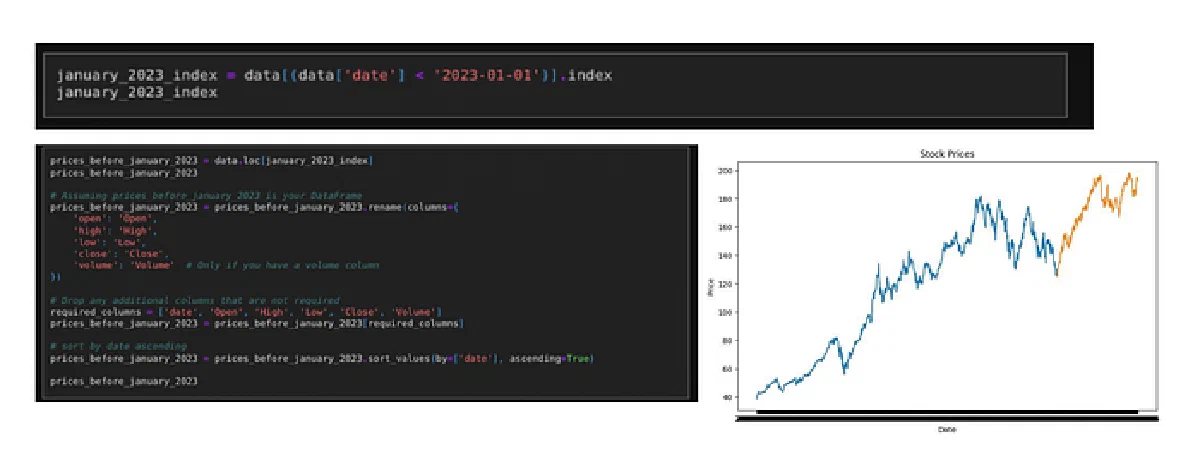
Pull full history for AAPL, split at 2023-01-01:
- Train — estimate mean/variance of log returns.
- Hold-out — compare simulated bands to realized closes.
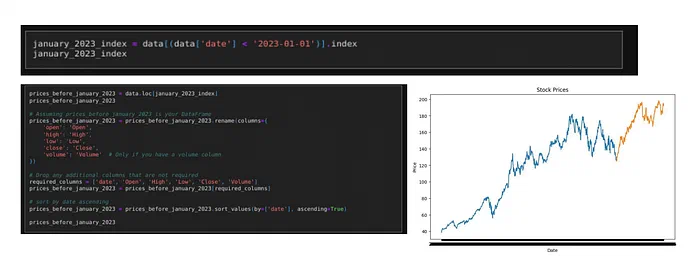
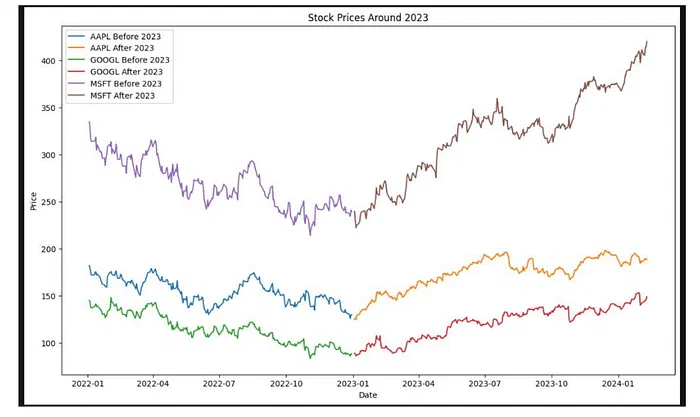
The same split for AAPL, GOOGL and MSFT shows how differently the three names moved after January 2023:
4. The simulation core
Estimate log returns on train window → daily drift and volatility → draw Gaussian shocks → propagate price with exp(drift + vol * Z).
def monte_carlo_simulation(data, days, iterations):
    if isinstance(data, pd.Series):
        data = data.to_numpy()
    if not isinstance(data, np.ndarray):
        raise TypeError("Data must be a numpy array or pandas Series")

    log_returns = np.log(data[1:] / data[:-1])
    mean = np.mean(log_returns)
    variance = np.var(log_returns)
    drift = mean - (0.5 * variance)
    daily_volatility = np.std(log_returns)

    future_prices = np.zeros((days, iterations))
    current_price = data[-1]
    for t in range(days):
        shocks = drift + daily_volatility * norm.ppf(np.random.rand(iterations))
        future_prices[t] = current_price * np.exp(shocks)
        current_price = future_prices[t]
    return future_prices
norm.ppf(np.random.rand(iterations)) turns uniform draws into standard normal shocks, so each row of future_prices is one trading day across every simulated path. The - 0.5 * variance term is the Itô correction: without it, the mean of exp(shock) would drift upward faster than the historical returns justify.
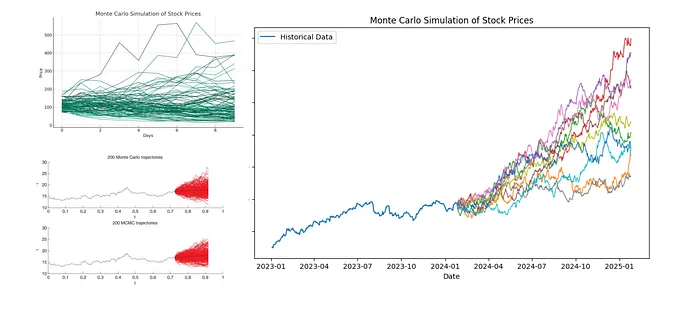
Data download helpers and plotting loops: Medium original[2].
5. Reading the output
- Fan of gray paths — scenario diversity.
- Median and mean paths — central tendency (not identical under skew).
- 5th–95th band — risk-style interval for “where might price land.”
- Hold-out dot — did reality sit inside the band at the aligned horizon?
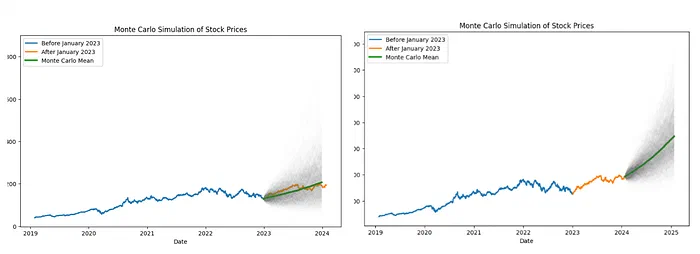
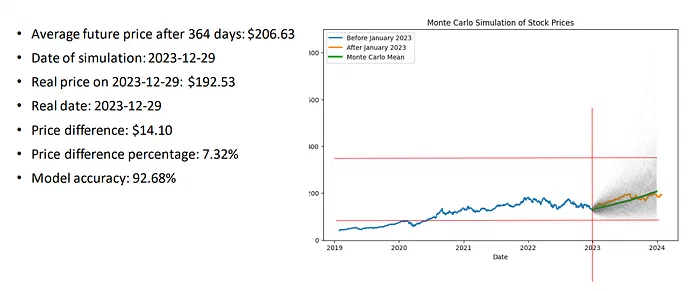
For AAPL, the mean simulated price after 364 days was $206.63 against a real close of $192.53 on 2023-12-29: a gap of $14.10, or 7.32 %.
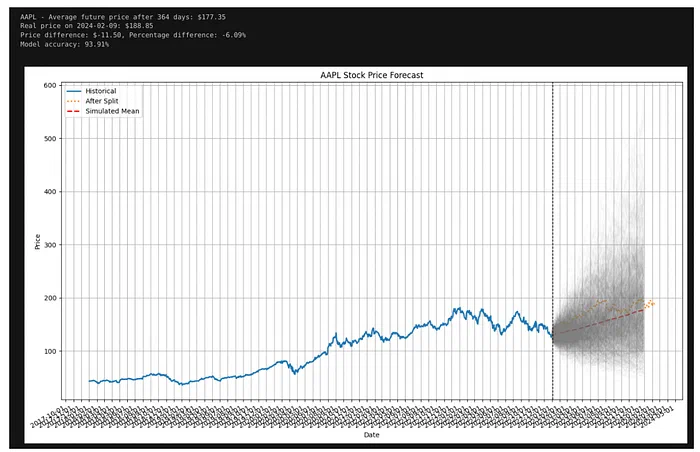
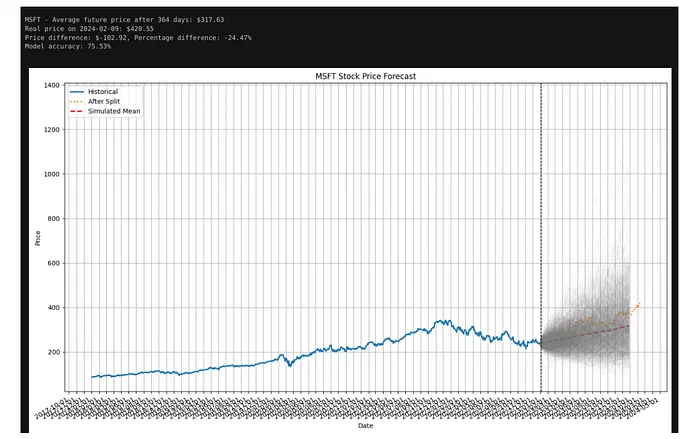
A later run for AAPL and MSFT, with the 2024 closes as the check, gives wider fans. The MSFT mean missed by about 14 %, which is a reminder that a band built on past volatility says nothing about a re-rating.
Terminal distribution gives quantile prices and simple return percentiles vs last train close — useful for “how wrong is the model?” not “buy signal.”
6. When not to use GBM Monte Carlo alone
| Limitation | Reality |
|---|---|
| Constant vol | Markets cluster volatility |
| No jumps | Earnings gaps exist |
| Single name | Diversification ignored |
| Not a strategy test | Pair with backtesting posts |
7. Takeaway
Monte Carlo answers model risk width on a hold-out window; backtesting answers rule PnL. Keep the questions separate.
8. Related posts
9. Reference
- Landauskas, M. & Valakevičius, E. (2011). Modelling of Stock Prices by MCMC[3]
- Investopedia — Monte Carlo basics[4]
Originally published on Medium[2]. Notebook code: see repo and Medium for full listings.